
Operation Leg – 19th August 1941
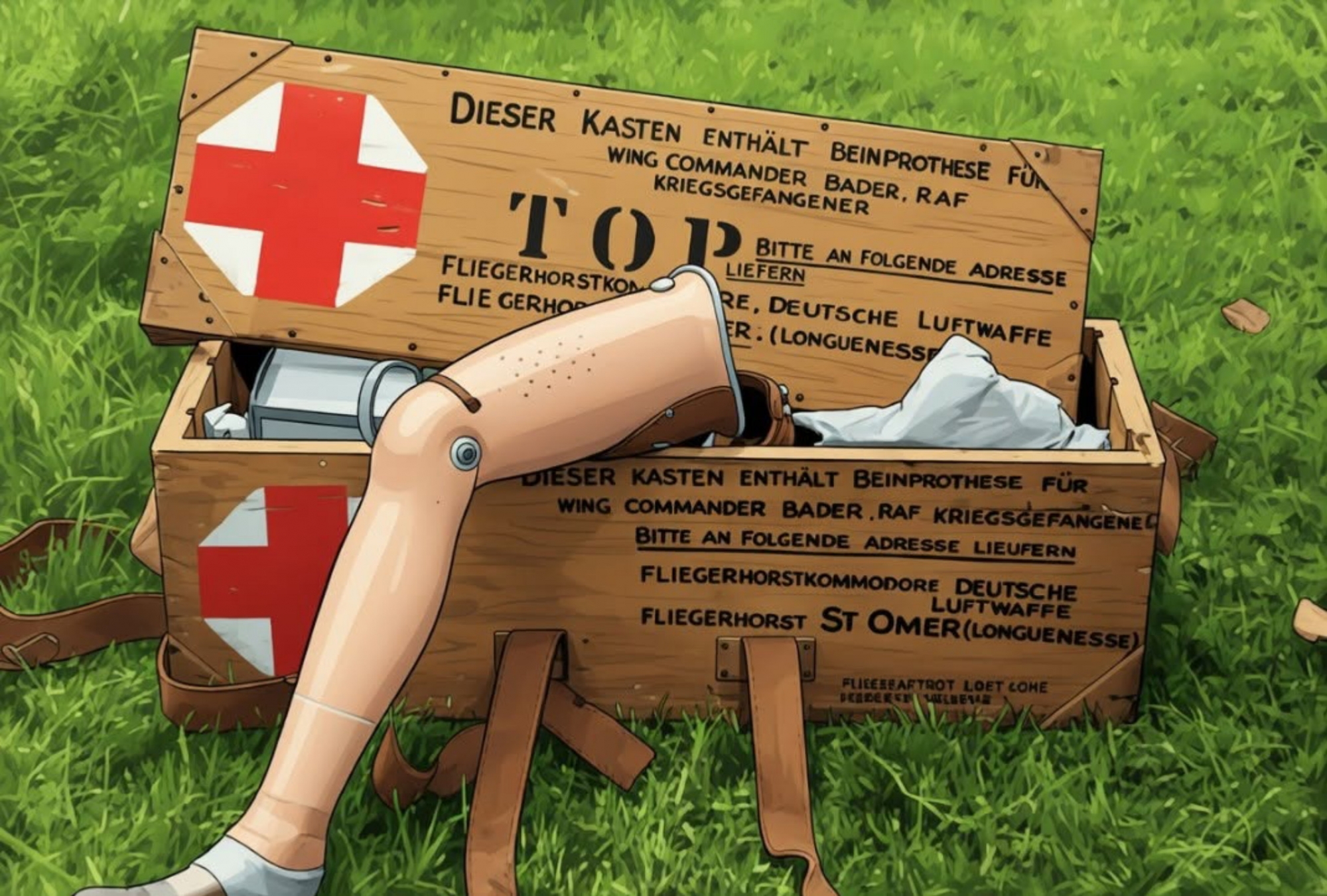
Header image: A spare prosthetic leg for the captured fighter ace Wg Cdr Douglas Bader, which was dropped by parachute near St Omer, France, on 19th August 1941. (Artwork from an original photo.)
Eighty-five years ago this month, on 19th August 1941, one of the more bizarre episodes of the Second World War unfolded, which has since become unofficially known as ‘Operation Leg’.
Douglas Bader is, perhaps, one of the most famous RAF fighter aces ever, and his story is well known to aviation enthusiasts. Having lost both his legs in a flying accident prior to the war, he managed to return to flying status and was eventually credited with 20 aerial victories, four shared victories, six “probables”, one shared probable and 11 enemy aircraft damaged. He led 242 Squadron and the controversial 12 Group ‘Big Wing’ during the Battle of Britain, and from March 1941 he was the Tangmere Wing Leader leading three Spitfire squadrons on fighter sweeps over France.
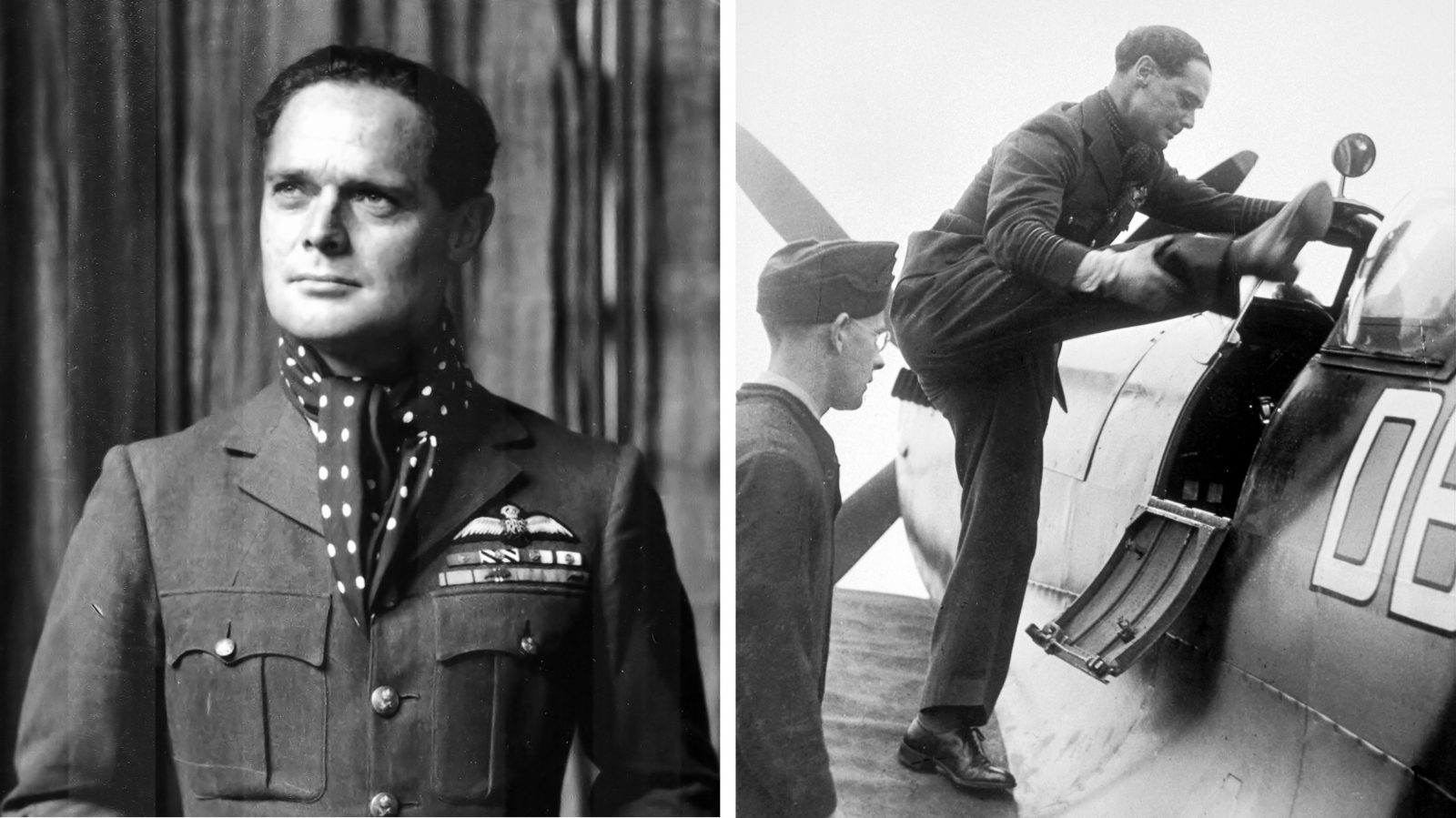
Right: This photo was taken after the war on 15th September 1945 when Bader was a Group Captain and before he flew a Spitfire on the Battle of Britain fifth anniversary flypast over London. It shows how he swung his right leg into the Spitfire cockpit.
On 9th August 1941, Bader’s Spitfire Mk Vb W3185 ‘D-B’ was brought down over enemy territory, and he was forced to bail out when the tail broke off. The exact cause of his demise is uncertain, although recent research suggests that he may have been the victim of ‘friendly’ fire. In his struggle to bail out, one of his artificial legs became trapped and snapped off as he eventually broke free.
After being captured, Bader was initially taken to the Luftwaffe hospital in St Omer. The Germans found his leg in a farmer’s field and made basic repairs to the battered prosthetic, which Bader then used to escape from the hospital on 18th August, although he was recaptured the following day. Already, though, the Germans had transmitted a signal on 13th August for the RAF to receive, stating: “Wing Commander Douglas Bader taken prisoner on 9 August 1941 lost his right leg while baling out. Bader requests that a new leg be sent. German permission granted to drop it by parachute. Communicate day and time of delivery by radio. Delivering aircraft will be granted safe conduct.”
RAF commanders were keen to find a way to get a spare leg to the captive Bader, but they were unwilling to give the Germans the propaganda coup that would almost certainly arise from an aircraft being given “safe passage”, so that option was dismissed out of hand. It was decided that the spare leg would be dropped during a routine bombing mission. On 19th August ‘Circus 81’ was planned for six Bristol Blenheims of 18 Squadron to attack the power station at Gosnay, supported by a large number of RAF Spitfires from the Tangmere, Hornchurch, Biggin Hill and Kenley Wings. One of the Blenheims would also drop the crated leg by parachute near St Omer. With no para-dropping options available, a standard seat-type parachute was strapped to the crate which would be manually thrown out of the Blenheim escape hatch, with the ripcord being pulled by hand as it went. Circus 81 had now become ‘Operation Leg’ although it was never officially designated as such.
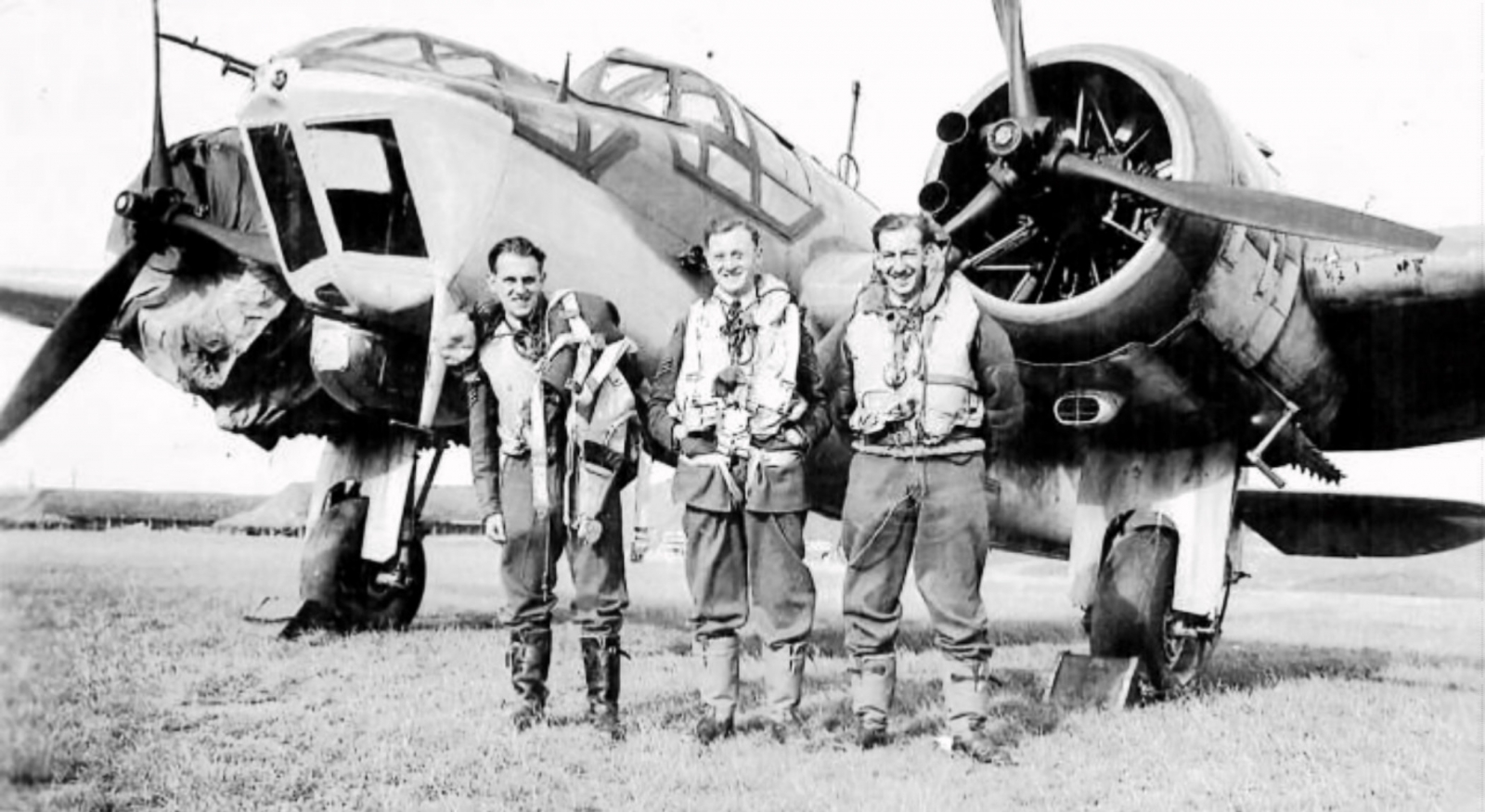
The aircraft tasked with delivering the leg was Blenheim R3843 ‘WV-F’ crewed by 19-year-old pilot Sergeant Jack Nickleson RCAF, 26-year-old Observer Sergeant Walter Meadows RAFVR and 25-year-old Wireless Operator/Gunner Sergeant John ‘Jack’ Pearson RAFVR. In the event, the Blenheims were unable to drop their bombs on the power station because the target area was obscured by cloud and, because of the danger to civilians, bombs could not be released randomly and had to be brought home. It was a different matter with the ‘special delivery’ though, and the nominated ‘air dispatcher’, Sergeant ‘Jack’ Pearson, performed his unusual task successfully, which was no mean feat. Meanwhile, an air battle was developing around the formation as German Bf 109s tangled with the Spitfires, and flak burst amongst the bombers. The crate carrying the leg was seen to descend by parachute, and despite being fired at it was not damaged. The safe receipt of the box by the Germans was acknowledged shortly afterwards by a wireless message.
Unfortunately, it was a costly operation. All six Blenheims were damaged by flak, with one of the observers being seriously injured in the thigh. Nine of the escorting Spitfires were shot down, most by Bf 109s, with the deaths of four pilots, another became a POW, one evaded capture and three were rescued from the sea. At least one other Spitfire pilot, Pilot Officer Don Willis of 452 Squadron, was wounded when his Spitfire was hit by cannon shells, but he managed to get home. Some of the Spitfires landed at Manston and Biggin Hill with virtually empty fuel tanks.
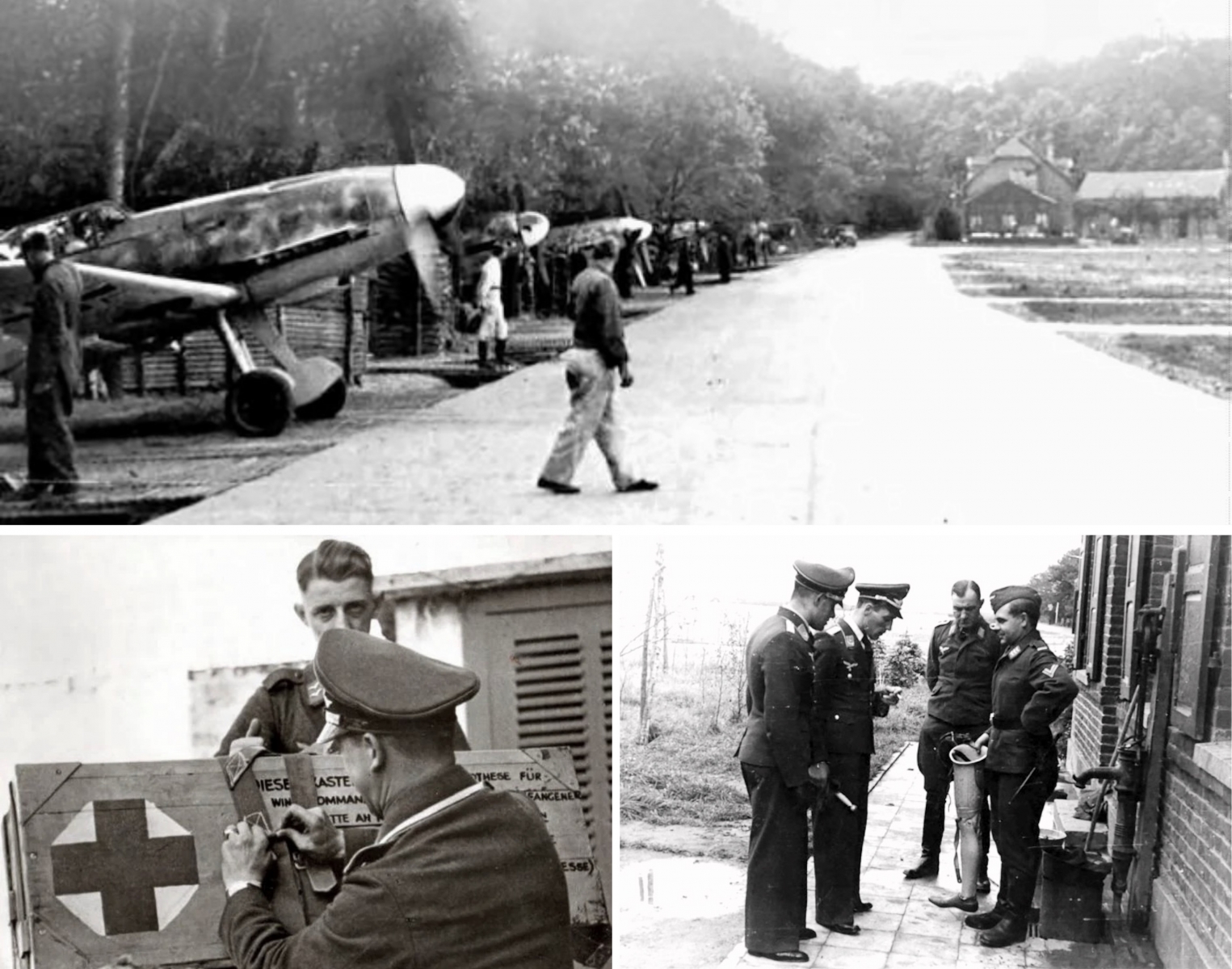
Lower left: A Luftwaffe officer unfastens the parachute harness from the crate containing Bader’s spare leg.
Lower right: Luftwaffe personnel inspect Bader’s replacement leg.
After the wooden box containing the leg drifted down through the flak near Longuenesse airfield, it was immediately recovered by the Luftwaffe who posed for the camera with the container and its curious contents. Re-captured on the very day of his leg delivery, the disgruntled Bader was nevertheless pleased to be shown the box containing his new leg, but was less thrilled to be almost immediately bundled into a truck for a bumpy ride into permanent captivity. As a POW, Bader was uncooperative, a constant source of irritation to his captors and, despite his physical disabilities, he made several escape attempts. Eventually, in August 1942, the Germans moved him to Colditz Castle, where he remained incarcerated until he was liberated by the First US Army Group in April 1945.
The Blenheim and the crew that dropped the leg for Bader were subsequently lost while attacking shipping off Zandvoort on 20th September 1941, just one month later. All three of the crewmen were killed. LEST WE FORGET